

You diligently study Spanish vocabulary lists, practice flashcards, and review grammar rules, yet weeks later you struggle to recall words you thought you’d mastered. This frustrating cycle of learning and forgetting wastes countless hours and undermines confidence. The problem isn’t your memory or dedication, it’s your review timing. Luckily, integrating the spaced repetition method into your study routine is an easy way to help boost memory retention.
The spaced repetition method (aka spaced repetition system or SRS for short) offers a scientifically proven solution to this universal learning challenge. By strategically timing your vocabulary reviews based on how memory actually works, spaced repetition ensures you remember Spanish words, phrases, and grammar long-term with minimal wasted effort. This technique, backed by over a century of cognitive science research, transforms Spanish vocabulary acquisition from an endless battle against forgetting into an efficient, systematic process.
Table of Contents
The Problem: Why You Forget Spanish Vocabulary
Understanding why we forget is the first step toward remembering effectively. The forgetting curve, discovered by German psychologist Hermann Ebbinghaus in 1885, reveals a predictable pattern in how humans lose newly learned information.
Ebbinghaus’s research demonstrated that without reinforcement, we forget approximately 50% of new information within hours of learning it. Within days, that figure rises to 70-80%. This rapid decay explains why cramming before tests produces short-term results that vanish quickly, and why Spanish vocabulary learned intensively during a weekend study session feels completely foreign by the following weekend.

The forgetting curve isn’t uniform, it follows an exponential decay pattern. You forget information most rapidly immediately after learning, then the rate of forgetting gradually slows. This means the most critical review period is within the first 24 hours of encountering new vocabulary. Miss that window, and you’re essentially starting from scratch.
Several factors influence how quickly you forget Spanish vocabulary. The depth at which you process information matters significantly; the material that’s meaningful or connected to existing knowledge persists far longer than isolated facts. Words you’ve used in conversation stick better than words only encountered in lists because you’ve engaged with them more deeply. Emotional connections, like learning “albergue” (hostel) after visiting one in Spain, create stronger memories than abstract study because they involve multiple sensory and emotional associations.
The forgetting curve presents a challenge, but also an opportunity. Because forgetting follows a predictable pattern, you can time reviews strategically to interrupt the forgetting process at optimal moments, dramatically improving retention with minimal additional study time.
The Mechanism: How Active Recall Strengthens Memory
Active recall is the process of retrieving information from memory without prompts or cues. Unlike passive review (re-reading notes or reviewing vocabulary lists), active recall requires your brain to work to retrieve information, and this effort fundamentally changes how memory works.
When you actively recall Spanish vocabulary, you strengthen the neural pathways associated with that word. An example of this is seeing a dog and retrieving “perro” from memory rather than just reading “dog = perro.” Each successful retrieval makes future retrieval easier and faster. This is why testing yourself proves more effective than simply reviewing material.
The testing effect, demonstrated across hundreds of studies, shows that retrieval practice produces better long-term retention than equivalent time spent passively reviewing. Struggling to remember a word, even if you initially fail, creates stronger memories than effortlessly re-reading it. This counterintuitive finding means that difficulty during practice actually benefits learning.
Active recall works because retrieval itself is a memory modifier. Each time you successfully recall “biblioteca” means “library,” you’re not just accessing a stored fact, you’re strengthening the storage itself. The neural connections become more robust, making future recall more automatic.
However, active recall alone isn’t enough for efficient learning. Reviewing all vocabulary daily through active recall would be time-consuming and inefficient. You’d waste time reviewing words you already know well while neglecting words on the verge of being forgotten. This is where strategic timing of the spaced repetition method becomes crucial.
The Solution: How The Spaced Repetition Method Combines Both
The spaced repetition method combats the forgetting curve through strategically timed active recall practice, creating an optimal review schedule that maximizes retention while minimizing study time.
Instead of reviewing all vocabulary at fixed intervals, the spaced repetition method adjusts review timing based on how well you know each word. Words you struggle with appear frequently. Words you know well appear at increasingly longer intervals. This dynamic scheduling ensures you review material just before you’re likely to forget it; the exact moment when review has maximum impact.
The spacing effect, another well-established cognitive principle, shows that information reviewed at increasing intervals is retained better than information reviewed at consistent intervals. Your first review of “farmacia” might occur hours after initial learning. Your second review might happen the next day. Your third review a few days later. Your fourth review a week after that. Each successful recall pushes the next review further into the future.
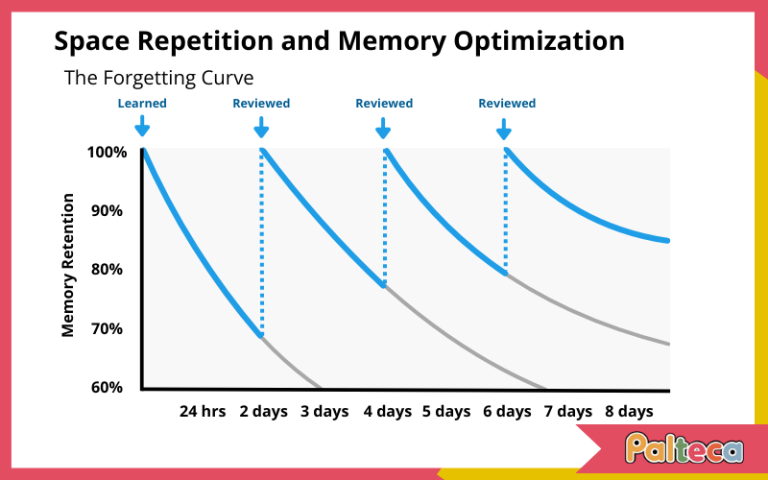
This exponential spacing accomplishes multiple goals simultaneously. It provides necessary reinforcement when memories are weakest (preventing forgetting), uses active recall to strengthen memory pathways, and eliminates wasted time reviewing well-known material. The efficiency gains are substantial. The spaced repetition method can reduce review time by 50-70% compared to traditional methods while producing superior retention.
The method works particularly well for Spanish vocabulary because word knowledge isn’t binary, you don’t either “know” or “not know” a word. Knowledge exists on a spectrum from vague recognition to instant automatic recall. Using the spaced repetition method helps move words along this spectrum efficiently, gradually transforming conscious retrieval into automatic recognition.
Implementing The Spaced Repetition Method for Spanish Learning
Now that you understand the theory, here’s how to apply the spaced repetition method effectively to your Spanish vocabulary acquisition: the process of gaining and internalizing new Spanish knowledge. While acquisition refers to initially learning vocabulary through exposure and study, spaced repetition ensures you retain what you’ve acquired by reviewing it at optimal intervals.
Choose the Right Content
Not all vocabulary deserves equal attention through spaced repetition. Prioritize high-frequency words, the 1,000-2,000 most common Spanish words that comprise the majority of everyday conversation. Learning “perro” (dog) through spaced repetition makes sense. Learning “ornitorrinco” (platypus) probably doesn’t unless you’re planning to have zoology discussions in Spanish.
Create cards for vocabulary you’ve encountered in context rather than pre-made lists of random words. If you learned “molesta” from a conversation where someone said “me molesta el ruido” (the noise bothers me), create a card with that full sentence, or even add an image. Context-based cards are more memorable and teach usage alongside meaning.
Include pronunciation information, especially for words with sounds difficult for English speakers. Adding audio to cards when possible helps you internalize correct pronunciation through spaced repetition of listening and speaking, not just reading and meaning.
Create Effective Cards
Good spaced repetition cards test one piece of information and provide clear feedback. The front might show an image or a Spanish sentence with a blank, and the back reveals the answer. Focus on one word or grammar rule per card, avoiding complex cards that test multiple concepts. They’re harder to review efficiently and provide unclear feedback about what you actually know.

Use images when possible instead of English translations. A picture of a dog paired with “perro” creates direct Spanish-to-concept associations, bypassing English translation. This approach builds the kind of direct thinking in Spanish that characterizes fluency.
Make cards bidirectional when beneficial. One card shows “biblioteca” and asks you imagine an image. Another shows an image of a library and asks for the Spanish word. Recognition (Spanish to English) is easier than recall (English to Spanish), so you’ll review these at different intervals based on your mastery of each direction.
If you’re interested in learning more strategies to help you start thinking directly in Spanish, you can check out our article, How to Think in Spanish: Stop Translating in Your Head.
Establish a Consistent Review Routine
The spaced repetition method works best with daily practice. Dedicate 10-15 minutes each day to reviewing cards due for practice. Consistency matters more than duration. Daily 15-minute sessions beat a 3 hour-long sessions once a week.
Review in order of urgency. Most spaced repetition systems automatically prioritize cards due soonest or cards you’ve struggled with previously. Trust the algorithm’s scheduling, it’s optimized based on forgetting curve research.
Be honest in your self-assessment. When a card asks for “farmacia” and you think “pharmacy… no wait, farmacia,” mark it as incorrect or difficult even if you eventually remembered. The spaced repetition method works by tracking your knowledge, and self-deception undermines the system’s effectiveness.
Balance New Cards with Reviews
Avoid overwhelming yourself with new vocabulary while maintaining review obligations. A sustainable pace adds 10-20 new cards daily while ensuring you complete all scheduled reviews. As your deck of flashcards grows, review load increases. Adding too many new cards creates an unsustainable review burden.
Most learners find that 10-15 new cards daily allows steady vocabulary growth while keeping daily review time reasonable. Adjust based on your available time and learning pace.
Missing reviews disrupts the spacing algorithm’s effectiveness and increases the possibility that you’ll forget the vocabulary word. So prioritize completing reviews over adding new material.
Tools and Apps for Spaced Repetition
Several tools implement algorithms for the spaced repetition method, each with different features and approaches.
Anki
Anki remains the gold standard for making flashcards and reviewing them with the spaced repetition method, offering complete customization and powerful features. This free, open-source program allows you to create custom decks, adjust algorithm parameters, add images and audio, and sync across devices.
Anki’s learning curve can intimidate beginners, the interface isn’t intuitive and the extensive customization options overwhelm initially. However, this complexity enables precise control over your learning experience. Pre-made Spanish decks are available, though creating custom cards from vocabulary you encounter naturally often proves more effective.
The algorithm is highly sophisticated, adjusting intervals based on multiple factors including how quickly you responded, how many times you’ve seen the card, and your self-assessed difficulty. For serious language learners willing to invest time learning the system, Anki offers a powerful tool to help boost vocabulary acquisition.
Anki’s strength is retention, not acquisition. The system assumes you’ve already learned vocabulary elsewhere and need systematic review to remember it long-term.
Quizlet
Quizlet provides a user-friendly, accessible introduction to spaced repetition with minimal learning curve. The “Learn” mode incorporates spaced repetition principles, adjusting which terms appear based on your performance.
While Quizlet’s algorithm is less sophisticated than Anki’s and offers less customization, its ease of use and social features, like sharing decks and studying with friends, make it popular for beginners. The platform offers numerous pre-made Spanish vocabulary sets, though quality varies.
Like Anki, Quizlet focuses on retention through review rather than initial vocabulary acquisition. You’ll need to learn Spanish vocabulary through other resources, like classes, apps, content, or immersion, before using Quizlet to maintain that knowledge long-term.
Quizlet works well for casual learners or those intimidated by more complex systems. However, serious long-term vocabulary acquisition typically benefits from more robust spaced repetition implementations or integrated platforms that combine learning with retention.
Palteca
Palteca integrates spaced repetition (SRS) into a Spanish comprehensible input learning platform, combining SRS with native speaker videos and structured content. The curriculum is designed to present vocabulary from lessons at spaced intervals, ensuring you review what you’ve learned at optimal times, going beyond simple flashcard review.
This integrated approach means you learn vocabulary in context through video content, then review it through spaced repetition, creating stronger associations than isolated flashcard study. The platform also includes basic flashcard creation tools, though not as customizable as Anki or Quizlet, and also uses a spaced repetition algorithm.
For learners who want the benefits of the spaced repetition method integrated with active Spanish learning, Palteca offers a guided experience that balances new content acquisition with strategic review of previously learned material.
Best Practices and Common Mistakes
Understanding common pitfalls helps you implement the spaced repetition method more effectively.
Creating too many cards at once overwhelms the review system. Adding 100 new vocabulary words in one session creates a grueling review burden within days. Steady, consistent addition of 10-15 cards daily builds sustainable long-term knowledge.
Making cards too complex undermines quick review. Cards testing multiple concepts simultaneously make it unclear which aspect you actually know. Keep one concept per card.
Skipping reviews breaks the spacing algorithm’s effectiveness. The system schedules reviews for specific days based on predicted forgetting. Missing reviews means reviewing either too late (you’ve already forgotten) or too early (the material is still fresh).
Passive card review defeats active recall benefits. Simply reading both sides of a card without attempting to recall the answer provides minimal benefit. Cover the answer, actively attempt retrieval, then check. The struggle to remember creates stronger mental connections.
Neglecting context makes words harder to remember and use. Create cards with related images, or full sentences showing word usage in context to dramatically improve retention and teach proper application simultaneously. The more personalized you make cards, like relating vocabulary to your interests or earlier memories, will help with long-term memorization.
Reviewing without application creates recognition without production ability. Supplement the spaced repetition method with conversation practice, writing, and listening. Using the spaced repetition method soldifies vocabulary knowledge; real-world use builds fluency.

Start Using The Spaced Repetition Method Today
The spaced repetition method transforms Spanish vocabulary retention from a frustrating cycle of forgetting into a systematic, efficient process backed by cognitive science. By understanding the forgetting curve, utilizing active recall, and timing review sessions strategically, you can master thousands of Spanish words while spending less time reviewing than traditional methods require.
Remember that the spaced repetition method is great for retention, keeping vocabulary you’ve learned in long-term memory. You still need quality resources for acquisition, actually learning new Spanish vocabulary through lessons, immersion, or content. The most effective approach combines both: acquire vocabulary through engaging Spanish content, then retain it through the spaced repetition method.
If you’re building a deck of flashcards, begin small. Choose a spaced repetition tool, create or download a starter deck of 100-200 high-frequency Spanish words, and commit to 15 minutes of daily practice. As the system proves itself through improved retention and reduced review burden, gradually expand your deck and refine your card creation. Remember to personalize each card to maximize recall and retention.
Ready to transform your Spanish vocabulary retention? Palteca’s integrated approach combines spaced repetition with comprehensible input from native speakers, ensuring you learn vocabulary in context and review it at optimal intervals. The platform handles the complexity of spaced repetition timing and scheduling while you focus on learning.
Your journey to permanent Spanish vocabulary mastery starts with understanding how memory works, and now you do. The next step is simply beginning.
Frequently Asked Questions About The Spaced Repetition Method for Spanish
How long does it take to see results from the spaced repetition method?
Most learners notice improved retention within 2-3 weeks of consistent daily practice. The difference becomes particularly apparent when you encounter vocabulary in real contexts. Words reviewed through spaced repetition feel familiar and accessible, while words studied through traditional methods feel vague or completely forgotten. After 1-2 months, you’ll likely find that vocabulary learned through the spaced repetition method requires significantly less effort to recall and persists much longer than words studied through cramming or passive review. However, the spaced repetition method is a long-term strategy, not a quick fix. The real benefits compound over months and years as thousands of words move into permanent long-term memory.
Can complete beginners use the spaced repetition method, or should I wait until I'm more advanced?
Beginners can and should use the spaced repetition method from the start, but with the right approach. Focus initially on high-frequency vocabulary, the 500-1,000 most common Spanish words that form the foundation of everyday conversation. Avoid overwhelming yourself with obscure vocabulary or complex grammar concepts before you have basic communication ability. Start with 5-10 new cards daily rather than 20+ to build the habit without creating excessive review burden.
As a beginner, also remember that spaced repetition handles retention, not initial learning. Pair it with beginner-friendly resources like apps, courses, or lessons that actually teach you Spanish vocabulary and grammar before you add it to your spaced repetition system.
What's better: Anki, Quizlet, or a platform like Palteca?
The “best” tool depends on your learning style and goals.
Anki offers maximum power and customization for serious learners willing to invest time learning the system and creating quality cards. It’s free, works offline, and provides sophisticated algorithm control.
Quizlet provides an easy, social, beginner-friendly experience but with less robust spaced repetition implementation, good for casual learners or those intimidated by complexity.
Palteca and similar integrated platforms offer the advantage of combining vocabulary acquisition (learning new words through lessons and content) with spaced repetition for retention, reducing the need to manually create cards or find external learning resources.
If you want one system that handles both learning and reviewing, choose an integrated platform. If you prefer maximum control and are comfortable with manual setup, choose Anki.
How many vocabulary cards should I review per day?
This depends on your available time and how many cards are due for review. Most learners find that 15-20 minutes of daily review is sustainable long-term. In practice, this typically means reviewing 50-150 cards daily, depending on how quickly you can recall them and how many are due. When starting fresh, you might only review 10-20 cards daily. As your deck grows over weeks and months, daily review load increases to perhaps 100-200 cards, but well-mastered cards space out to weeks or months between reviews, preventing indefinite growth. Focus on consistently reviewing your due cards daily, rather than hitting specific numbers. Missing review days disrupts the spacing algorithm and creates catch-up burden.
Should I create my own flashcards or use pre-made decks?
Both approaches have merit. Pre-made decks offer convenience and comprehensive coverage of common vocabulary, making them excellent for beginners building foundational vocabulary quickly. However, the act of creating cards, finding example sentences, choosing context, adding personal notes, is what enhances learning and creates cards more relevant to your specific needs and interests.
A hybrid approach works well: use pre-made decks for high-frequency core vocabulary (your first 1,000-2,000 words). Personalize the cards that you find yourself having difficulty remembering, by adding images, and sentences using the word in context. Then create custom cards for vocabulary you encounter through reading, listening, or conversation. Words you’ve personally encountered and chosen to learn typically stick better than random words from someone else’s deck.
Can the spaced repetition method help with grammar, or is it only for vocabulary?
The spaced repetition method works for any information that requires memorization, including grammar patterns, verb conjugations, and sentence structures. However, grammar often benefits from different card designs than vocabulary. Instead of “what does this word mean,” grammar cards might show a sentence with a blank and ask you to conjugate a verb correctly, or present an English sentence for you to express entirely in Spanish. Many learners find that the spaced repetition method helps solidify grammar rules they’ve already learned through lessons or practice, but it’s less effective for initially understanding complex grammatical concepts. You still need clear explanations and examples before creating grammar review cards.
What happens if I miss several days of reviews?
Missing a few days creates catch-up burden but doesn’t ruin your progress. The cards you missed will accumulate, and you’ll have more reviews than usual when you return. Spaced repetition algorithms typically treat overdue cards as if you’re seeing them for the first time at that review stage, potentially moving them back to shorter intervals if you struggle with them. To recover from missed days, resist the temptation to catch-up by reviewing everything at once. This creates mental fatigue and poor retention. Instead, spread catch-up reviews over several days, prioritizing the most overdue cards first, and avoiding creating new cards. If you’ve missed weeks or months, consider the deck partially “expired” and be prepared to relearn some vocabulary that’s moved back toward the forgetting curve. The foundation remains, but you’ll need to rebuild some connections through consistent practice.