

How Long Would It Take to Learn Spanish?
Learning Spanish would typically take 600-750 hours of study for English speakers, according to the Foreign Service Institute. At one hour per day, that’s roughly 2-2.5 years to reach conversational fluency. However, there are several factors to consider when asking how long would it take to learn Spanish. Your timeline varies based on your learning method, daily practice time, and what you mean by “learn Spanish.”
The good news? You don’t need to wait years to use Spanish. You can have basic conversations within months and navigate Spanish-speaking countries comfortably long before reaching “fluency.” The key is understanding what timeline applies to your specific goals and choosing a learning method that actually works.
Let’s break down realistic timelines based on different proficiency levels, how various factors affect your learning speed, and what you can do to learn Spanish as efficiently as possible.
Table of Contents
How Long Would It Take to Learn Spanish at Different Levels?
Basic Spanish (great for tourism) takes 3-6 months, conversational fluency takes 1-2 years, advanced fluency takes 2-4 years, and proficient-level Spanish takes 4+ years of consistent daily practice. These timelines assume 30-60 minutes of daily study using effective, comprehensible input methods.
Here’s what you can expect at each level:
Basic/Tourist Spanish (A1-A2 Level)
- Timeline: 3-6 months with daily practice
- Hours needed: 100-200 hours
- What you can do: Order food, ask directions, handle basic needs, understand simple conversations
- What you can’t do yet: Discuss complex topics, understand fast native speech, or work in Spanish
Conversational Fluency (B1-B2 Level)
- Timeline: 1-2 years with consistent daily practice
- Hours needed: 300-700 hours
- What you can do: Hold extended conversations, watch Spanish TV with good comprehension, express complex ideas, navigate daily life comfortably
- What you can’t do yet: Handle all professional situations or understand every regional dialect
Advanced Fluency (C1 Level)
- Timeline: 2-4 years with regular immersion-level exposure
- Hours needed: 700-900 hours
- What you can do: Work professionally in Spanish, understand virtually everything, express subtle nuances, read literature
- What you may still have: A slight accent, occasional word-searching moments
Proficient/Near-Native (C2 Level)
- Timeline: 4+ years of immersive practice
- Hours needed: 1000+ hours
- What you can do: Function at native-level in virtually all contexts, understand regional slang and cultural references, handle specialized professional terminology
- Note: Very few non-native speakers reach this level, and most don’t need to for their goals
The important takeaway: When you’re asking how long would it take to learn Spanish, you need to consider your goals. “Learning Spanish” means different things to different people. You might reach your personal goals in 6 months (travel fluency) or need 3+ years (proficient fluency). Both are valid achievements. Don’t let perfect be the enemy of good.
What Affects How Long It Would Take to Learn Spanish?
Five main factors determine your Spanish learning timeline: your learning method (comprehensible input vs. traditional), daily time commitment, consistency of practice, previous language experience, and your personal definition of “fluent.” Method and consistency matter most. Consistent practice with Spanish comprehensible input produces better results than sporadic grammar study.
Your Learning Method
This is the biggest factor. Methods like Spanish comprehensible input, where you learn through understanding meaningful Spanish content, produce fluency faster than traditional translation-based approaches. When you focus on understanding Spanish directly rather than translating everything through English, your brain builds the right neural pathways for natural fluency.
Traditional grammar-translation methods can leave you able to conjugate verbs perfectly but may not properly prepare you to hold a conversation. Research by linguist Stephen Krashen shows that language acquisition happens through understanding messages, not through studying about the language.
Daily Time Commitment
More hours per day accelerates your timeline, but there are diminishing returns:
- 15-30 minutes daily: Steady progress, 3-4 years to conversational fluency
- 30-60 minutes daily: Good balance, 1.5-2.5 years to conversational fluency
- 1-2 hours daily: Accelerated timeline, 10-18 months to conversational fluency
- 3+ hours daily: Intensive immersion, 9-12 months to conversational fluency
Consistency vs. Intensity
Daily 30-minute sessions often work better than weekly 3-hour marathons. Your brain needs regular exposure to solidify patterns. Repetition not only helps you retain what you’ve learned, it also helps make stronger mental connections. Studying intensely for a month then taking two months off resets much of your progress.
Previous Language Experience
If you already know a similar language like, Portuguese, Italian, or French, you’ll learn Spanish faster due to vocabulary overlap and similar grammar. Even learning any second language previously helps since you already understand what language learning feels like and have developed learning strategies.
English speakers have an advantage with Spanish: thousands of cognates (similar words like “hospital,” “importante,” “familia“) give you a significant head start.
Your Definition of “Learned”
Are you trying to order tacos confidently, have deep conversations with family, or work as a translator? Your goal dramatically changes your timeline. Be specific about what “learning Spanish” means for you, and set your expectations accordingly.
How Many Hours Would It Take to Learn Spanish?
The Foreign Service Institute estimates 600-750 classroom hours to reach what they consider “General Professional Proficiency” for English speakers. They use the Interagency Language Roundtable (ILR) scale to identify this level of proficiency in students, which falls somewhere between conversational fluency (B2) and advanced fluency (C1).
At 30 minutes daily, this takes 3-4 years. At one hour daily, it takes 2-2.5 years. At two hours daily, it takes 1-1.5 years. Comprehensible input methods can make these hours more effective than traditional classroom study.
Here’s what different daily commitments look like in practice:
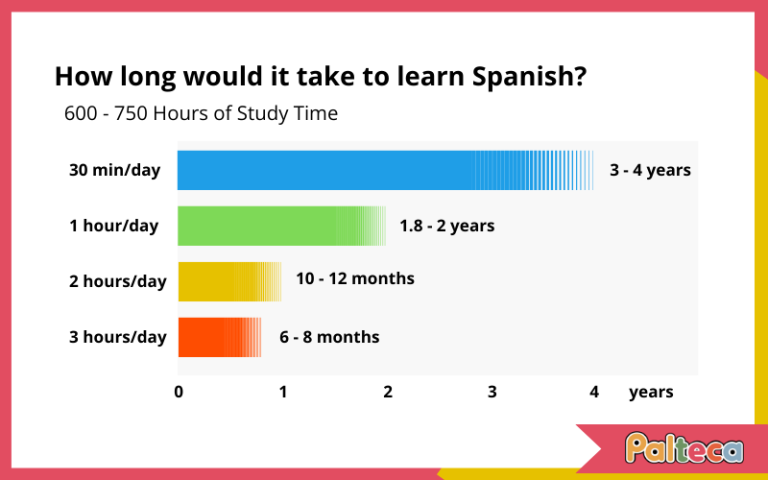
Key Insight: Doubling your daily practice time roughly halves your timeline to fluency. But remember: consistency matters more than intensity. 30 minutes daily beats 3 hours once a week.
Important context: The FSI data is based on classroom hours with professional instruction. Self-study with comprehensible input can be just as effective (sometimes more so) if you’re using quality resources and staying consistent. The key is the quality of your hours, not just the quantity.
Also remember: these timelines are for reaching “professional working proficiency” (roughly B2-C1 level). You’ll be able to have conversations and use Spanish practically long before hitting these hour counts.
How Would You Learn Spanish Faster Than Average?
Though very difficult, it is possible to learn Spanish faster than average by using Spanish comprehensible input instead of translation-based methods, practicing daily instead of sporadically, creating immersion at home, and starting speaking practice early. The fastest realistic timeline is 9-12 months to conversational fluency with 2+ hours daily of quality practice.
Strategies to accelerate your Spanish learning:
- Use comprehensible input from day one Instead of memorizing vocabulary lists and grammar rules, consume Spanish content that you can mostly understand through context. Apps like Palteca and resources like Dreaming Spanish provide content designed at your level. Your brain acquires language naturally when you understand meaningful messages. This is faster and more effective than translation-based study.
- Practice daily, no exceptions Even 15 minutes daily beats 2 hours once a week. Your brain needs regular exposure to build and strengthen neural pathways. Set a minimum daily commitment you can sustain for months, not an ambitious schedule you’ll abandon after two weeks.
- Create immersion at home You don’t need to move to Mexico to immerse yourself in Spanish. Change your phone to Spanish, watch Spanish YouTube, listen to Spanish podcasts during commutes, think in Spanish throughout your day. Use immersion-based apps like Palteca and Rosetta Stone to help simulate real-world situations with real native Spanish speakers. The more you surround yourself with Spanish, the faster you’ll acquire it.
- Start speaking early Don’t wait until you’re “ready.” Talk to yourself in Spanish, narrate your day, practice with language exchange partners. Speaking practice transforms passive knowledge into active ability. You need both input (listening/reading) and output (speaking/writing) to develop complete fluency.
- Focus on high-frequency vocabulary The most common 1,000 Spanish words account for about 85% of everyday conversation. Prioritize learning these high-frequency words in context rather than trying to memorize comprehensive vocabulary lists. You’ll be conversational faster by mastering what you’ll actually use.
- Be realistic about “faster” Even with optimal methods, Spanish fluency takes time. Beware of apps or courses promising fluency in “3 months” or “5 minutes a day.” These are marketing claims, not realistic timelines. True conversational fluency takes most people 1-2 years of consistent daily practice, and that’s okay. The journey is worth it.
While it’s tempting to accelerate your timeline with intensive study sessions, endless flashcards, and grammar drills, this approach usually backfires. Burnout is real, and when learning feels like a chore, many people often quit before reaching fluency. Instead, make Spanish relevant to your life and interests. If you love cooking, watch Spanish cooking shows. If you’re into sports, follow Spanish sports coverage. When you’re learning content you genuinely enjoy, you’ll practice consistently without it feeling like work, and that consistency is what leads to fluency. If you want to explore the different ways you can start learning Spanish, check out our Ultimate Guide for Spanish Lessons for Adults.
Ready to Start Your Spanish Journey?
Learning Spanish takes time, there’s no way around that. But it’s absolutely achievable, and every day of consistent practice brings you closer to your goals. Whether you’re aiming for tourist basics in 3 months or near-native fluency in 3 years, the path forward is clear: daily practice with comprehensible input.
The question isn’t just “how long would it take to learn Spanish,” it’s “when will you start?” Your timeline begins today.
Key takeaways:
- Expect 1-2 years to conversational fluency with daily practice
- Comprehensible input methods are more effective than translation-based study
- Consistency matters more than intensity – daily practice wins
- You’ll be using Spanish long before you’re “fluent”
- The sooner you start, the sooner you’ll reach your goals
Ready to learn Spanish the proven way? Download Palteca and start building real Spanish fluency through comprehensible input. We won’t promise fluency in a month. What we will do is give you the most effective method, comprehensible input combined with strategic practice, to reach your Spanish goals as efficiently as possible.