

Effective language learning isn’t about how many hours you spend studying, it’s about which techniques you use during those hours. Whether you’re learning Spanish, French, or Mandarin, the methods that accelerate fluency remain consistent. Understanding these evidence-based techniques helps you avoid inefficient approaches and focus your energy where it counts. This guide introduces the most effective language learning techniques, with Spanish examples throughout, giving you a framework for building your own optimized learning system.
Table of Contents
Understanding Input vs Output
Before exploring specific techniques, it’s essential to understand the two fundamental modes of language learning: input and output.

Input refers to consuming language. Listening, reading, and watching.
When you watch a Spanish series, listen to a podcast, or read an article, you’re engaging with input. This exposure helps your brain recognize patterns, internalize grammar structures, and absorb vocabulary in context. Input builds your passive understanding and forms the foundation for everything else.
Output means producing language. Speaking and writing.
When you have a conversation in Spanish, write in a journal, or practice pronunciation, you’re creating output. This active production strengthens neural pathways, reveals gaps in your knowledge, and builds the fluency needed for real communication.
Both are essential for reaching fluency. Input without output leaves you understanding far more than you can express. Output without sufficient input leads to fossilized errors (deeply ingrained mistakes that become difficult to correct) and limited vocabulary. The most effective learners balance both, using different language learning techniques optimized for each mode.
Input-Based Methods
Input-based language learning techniques focus on how you consume Spanish, building your comprehension and exposing you to natural language patterns.
Comprehensible Input
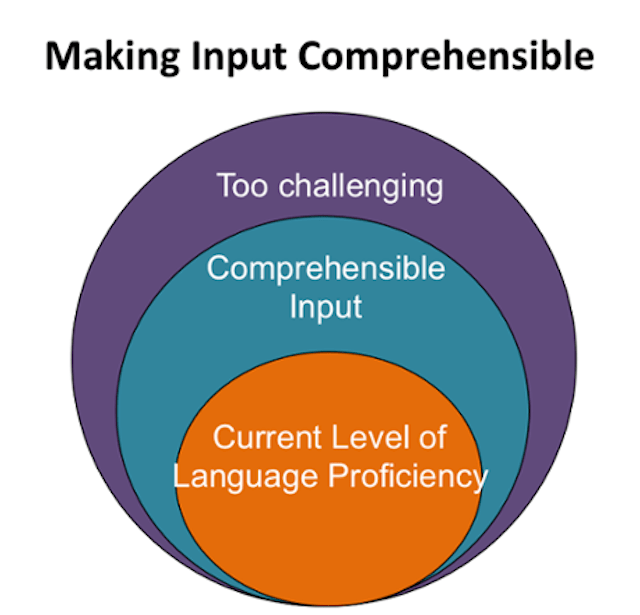
Comprehensible input, a concept developed by linguist Stephen Krashen, refers to content that’s slightly above your current level. It should challenging enough to teach you new things but understandable enough that you can follow along. This “i+1” approach (where i is your current level) allows your brain to naturally acquire language structures without explicit grammar study. For Spanish comprehensible input, this can mean starting with podcasts designed for beginners, then gradually transitioning to native content as comprehension improves. Look for resources like Spanish-speaking movies, podcasts, and graded readers. Apps like Palteca, and Dreaming also offer content that introduces new, relevant content, while reviewing previously learned concepts. Learn how these apps use comprehensible input in this Dreaming Spanish Review and comparison guide.
The distinction between comprehension versus acquisition matters here. Comprehension is conscious understanding, you know what a word means. Acquisition is subconscious internalization, the word becomes available for automatic use without thinking. Comprehensible input drives acquisition, not just comprehension.
Immersion
Immersion surrounds you with the target language throughout your day. Unlike comprehensible input, immersion includes content at all levels, even material you can’t understand at all. The constant exposure helps your brain tune into the sounds, rhythms, and patterns of Spanish.
You don’t need to move to Mexico or Spain to create immersion. Digital immersion adds hundreds of micro-exposures to your day. This includes simple actions during your daily routine like changing your phone to Spanish, following Spanish social media accounts, or listening to Spanish radio. Even the content you have trouble understanding contributes by training your ear to distinguish Spanish sounds, patterns, and word boundaries.
For learners looking for a more structured approach, look for Spanish courses or tutors that offer content with little to no translations. Beyond the classroom, apps like Palteca and Rosetta Stone also offer an immersive experience, offering courses completely in Spanish.
You can read more here about how you can use Spanish Immersion to learn a new language whether you’re studying abroad or at home.
Authentic Media and Content
Authentic Spanish media, like podcasts, YouTube videos, Netflix series, social media, and news sites, provides unfiltered exposure to how native speakers actually use the language. Unlike materials designed for learners, authentic content presents real-world vocabulary, current slang, cultural references, and natural speech patterns.
Start with content about topics you already understand well. If you follow technology news in English, reading Spanish tech blogs leverages your existing knowledge, making comprehension easier even when vocabulary is unfamiliar. Spanish podcasts allow you to learn during commutes or workouts, while YouTube channels offer visual context that aids understanding.
Social media platforms like Instagram, Twitter, and Reddit provide bite-sized Spanish exposure throughout your day. Following Spanish-language accounts related to your interests, whether fitness, cooking, or software development, it will create passive touchpoints with the language. Even scrolling through memes or reading comment threads exposes you to colloquial expressions and cultural context you won’t find in textbooks.
The key is choosing content slightly above your level when possible, but don’t avoid material that interests you just because it’s challenging. Struggling through an engaging Spanish podcast teaches more than easily understanding boring content.
Listening Improvement Techniques
Listening comprehension often lags behind reading ability because spoken Spanish moves quickly, blends words together, and includes regional accents and pronunciation variations. Targeted listening practice is a language learning technique that accelerates your ability to understand native speech.
Minimal pairs are word pairs that differ by only one sound, like “pero” (but) and “perro” (dog), or “mesa” (table) and “misa” (mass). Practicing minimal pairs with apps like Palteca, trains your ear to distinguish subtle sound differences that don’t exist in English. This focused listening practice is particularly valuable for sounds like r/rr, b/v, and vowel distinctions that English speakers commonly struggle with.
Strategic subtitle use helps bridge the gap between written and spoken Spanish. Start with Spanish audio and Spanish subtitles. This connects what you hear to how it’s written, helping you recognize word boundaries and pronunciation patterns. As comprehension improves, remove subtitles entirely to challenge yourself. Avoid English subtitles while listening to Spanish, as this encourages translation rather than direct comprehension.
Repetitive listening to the same content multiple times reveals details you missed initially. Your first listen might capture the main idea, the second catches more vocabulary, and the third picks up grammar structures and nuances. This approach works especially well with short podcasts or YouTube videos where you can replay easily.
Graded Readers
Graded readers provide progressive difficulty texts designed for learners. Using a similar approach to comprehensible input, these books use controlled vocabulary and simplified grammar, gradually introducing complexity as you advance through levels. They bridge the gap between textbook exercises and authentic native content, building reading stamina and vocabulary in context. Starting with A1-level readers and progressing through B1, B2, and beyond provides a structured reading progression that matches your development.
Traditional Learning Methods

Traditional learning methods remain widely used in formal education systems. This approach typically includes instruction through lectures and textbooks, note-taking, vocabulary list memorization, and explicit grammar rule study. While structured instruction can clarify concepts and provide organized understanding of Spanish grammar and syntax, these methods alone don’t fully prepare learners for real-world communication.
Traditional approaches often emphasize accuracy over fluency, leading learners to translate mentally rather than think directly in Spanish. This reliance on translation slows natural language use and can create a gap between what you understand academically and what you can produce spontaneously in conversation. Most effective learners combine traditional methods with input-based and active practice techniques rather than relying exclusively on classroom-style study.
Output-Based Methods and Active Learning
Output-based language learning techniques focus on actively using what you’ve learned. This requires producing Spanish, transforming passive knowledge into usable fluency. Before exploring output-based methods, it might be helpful to know the difference between passive learning and active learning, and why it’s important to bridge these two together.
Passive vs Active Learning
Passive learning happens when language exposure occurs in the background, like Spanish music while working, a podcast during your commute, or a series playing while cooking. It’s a form of input that lets our brain observe and absorb Spanish.
Active learning requires focused attention, including studying with intent, taking notes, or deliberately processing what you hear. A combination of intentional input and output contribute to active learning.
Passive and Active learning both have value. Passive exposure maintains contact with the language and reinforces patterns you’ve already learned. Active study introduces new material and strengthens retention. The key is recognizing that passive exposure alone won’t drive progress, it supplements active learning but can’t replace it.
Shadowing
Shadowing involves listening to native Spanish speakers and immediately repeating what they say, matching their pronunciation, rhythm, and intonation as closely as possible. The shadowing technique strengthens your speaking muscles, improves your accent, and helps you internalize natural speech patterns. Start with slower, clearer speakers and progress to natural-speed conversation as your ability improves.
Shadowing doesn’t require specialized equipment or paid content. Mimic a line or two while listening to a Spanish podcast, or use resources like Forvo and WordReference to hear pronunciations of native Spanish speakers from around the world. However, there are some paid resources, like Palteca and Rocket Languages an are useful for giving real-time feed back on your pronunciation without having to practice in-front of a real person..
Language Exchanges

Language exchanges connect you with native Spanish speakers who want to learn or practice their English, creating mutually beneficial practice opportunities. These real conversations force you to retrieve vocabulary, construct sentences in real-time, and navigate authentic communication challenges. Apps and online platforms like MeetUp, HelloTalk, and Tandem, make finding exchange partners straightforward, and even 15-minute weekly conversations accelerate speaking progress significantly. These may seem intimidating at first, but are great practice if you prepare ahead of time to get the most of out of your language exchange.
Tutors and Classes
Tutoring and classes are great for active input and output. Professional instruction provides structured guidance, immediate feedback, and accountability. Tutors identify errors you might not catch yourself and can explain grammar concepts when self-study stalls. Classes add social accountability and structured progression. While self-directed learning works well for motivated individuals, periodic professional input accelerates progress and prevents fossilized errors. Look for in-person classes and tutors in your area, or connect with teachers from around the world on platforms like Preply and iTalki.
Journaling
Writing in Spanish without the pressure of immediate communication allows you to practice constructing sentences, experiment with new vocabulary, and track your progress over time. Journaling reveals patterns in your errors and shows you which grammar points need reinforcement. Even five minutes daily builds writing fluency and confidence. Look here for some ideas to help start a journal in Spanish.
Input vs Output Balance
Finding the right ratio between input-based and output-based language learning techniques depends on your level. Beginners benefit from heavy input by building vocabulary and pattern recognition before extensive speaking practice. Intermediate learners need more balanced exposure, while advanced learners often need to increase output to sound more natural and converse spontaneously. A common mistake is excessive input without sufficient output practice, leaving learners who understand far more than they can express.
Memory and Retention Techniques
Even with excellent input and output practice, retention techniques determine how much you actually remember long-term.
Combating the Forgetting Curve

The forgetting curve, discovered by psychologist Hermann Ebbinghaus, shows that we forget approximately 50% of new information within days unless we review it. Understanding this curve explains why cramming fails and why repetition over longer periods of time works. Each review strengthens memory and extends the time before you forget, eventually moving information into long-term memory.
Spaced Repetition Systems
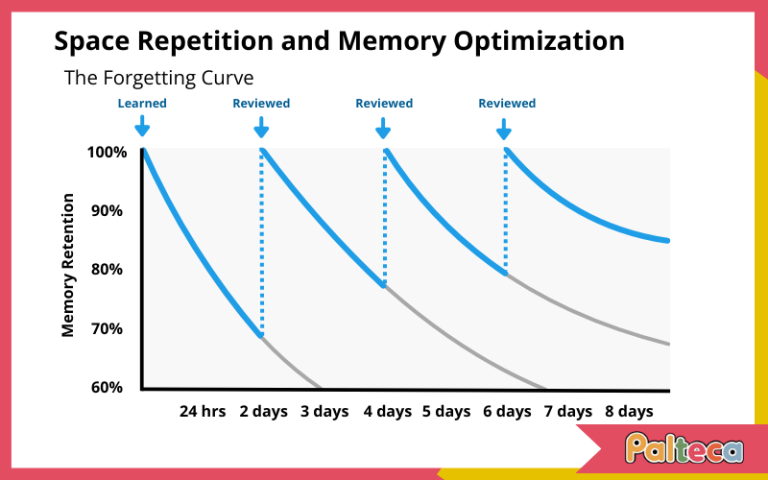
Spaced repetition systems (SRS) like Palteca and Anki use algorithms to optimize when you review material. Instead of cramming or random review, SRS presents information just before you’re likely to forget it, maximizing retention while minimizing review time. This language learning technique leverages the spacing effect – the scientific finding that information reviewed at increasing intervals is retained better than information reviewed at consistent intervals.
Flashcards and Visual Memory
Effective flashcards pair Spanish words with images rather than English translations, creating direct associations that bypass mental translation. Visual memory strengthens these connections, your brain remembers pictures better than words. The key is including context: full sentences rather than isolated words, and personal relevance over generic examples.
Mnemonics
Different types of Mnemonics are a powerful language learning technique that create memorable associations that help you recall difficult words or concepts. These memory tricks can be particularly powerful for vocabulary that doesn’t stick perhaps due to abstract meanings, unfamiliar sounds, or lack of English cognates.
For example, remembering that “embarazada” means pregnant (not embarrassed) becomes easier with a vivid mental image, perhaps something that is very outlandish. Mnemonics work especially well for beginners building initial vocabulary and for intermediate learners tackling stubborn words that resist other techniques.
The key is using mnemonics strategically rather than exclusively. When used wisely, they can pair well with context learning and comprehensible input.
Context Learning
Learning words within phrases and sentences rather than isolation dramatically improves retention and usability. When you learn “hacer” as part of “hacer ejercicio” or “hacer la tarea,” you acquire not just the word but its natural collocations and usage patterns. Context provides meaning, grammatical structure, and real-world application simultaneously.

Choosing the Right Language Learning Techniques
No single technique works best for everyone. Effective language learning combines multiple approaches matched to your goals, schedule, and learning preferences. An office worker with limited time might prioritize comprehensible input during commutes, brief SRS reviews during breaks, and weekly language exchanges. Someone with more flexibility might add tutoring sessions, extensive reading, and daily journaling.
It’s also important to find fun and relevant content. Not only will it keep you engaged, it will motivate you to want to learn more and explore. New information will be easier to remember and retain when you enjoy it and apply it to daily life.
The key is consistency with proven techniques, not perfection. Studying Spanish for 30 minutes daily using effective methods will always outperform sporadic marathon sessions with inefficient approaches. Experiment with different language learning techniques, track what works for you, and build a sustainable system you can maintain long-term.
Start Applying These Techniques Today
Understanding these language learning techniques gives you a framework for efficient, effective Spanish study. Whether you’re just beginning or looking to accelerate existing progress, combining input-based methods, active practice, and memory optimization creates comprehensive language development.
Ready to put these techniques into practice? Palteca incorporates these evidence-based methods into a structured learning system, helping you build fluency efficiently without wasting time on outdated approaches. The most important decision isn’t which single technique to use, it’s the decision to start applying them consistently today.