

Remember the days when you had to practice nothing but conjugations and never got to actually listen to real conversational Spanish? Gone are the days of these traditional methods of learning Spanish. Now thanks to new immersive methods, there are better and more fun ways of learning Spanish. Let’s dive into one of these immersive ways of learning Spanish, a comprehensive Dreaming Spanish review and how it stacks against other popular platforms, including Palteca.
Table of Contents

What Is Dreaming Spanish? An Overview
Dreaming Spanish is a video-based Spanish learning platform built entirely around Spanish comprehensible input (CI)—a language acquisition theory developed by linguist Dr. Stephen Krashen. The core idea is simple: you acquire language naturally by consuming content you can understand, rather than by memorizing grammar rules or drilling vocabulary.
Founded by Pablo Román, Dreaming Spanish takes this philosophy to its logical extreme. The platform offers over thousands of videos featuring native Spanish speakers from Mexico, Spain, Argentina, Colombia, Venezuela, and the Dominican Republic. Videos are categorized into difficulty levels.
Here’s what makes the Dreaming Spanish approach distinctive: there’s no English, no grammar explanations, no flashcards, and no exercises. You simply watch videos in Spanish from day one, using visual context, gestures, and gradually increasing complexity to absorb the language naturally.
How Dreaming Spanish Works: The Methodology Explained
The Dreaming Spanish method asks you to commit to a radically passive approach. According to their roadmap, learners should:
- Spend 0-50 hours watching Superbeginner content (very slow, highly visual)
- Progress through Beginner, Intermediate, and Advanced content over hundreds of hours
- Wait until 300+ hours before starting to read in Spanish
- Wait until 600+ hours before attempting to speak
Yes, you read that correctly. Dreaming Spanish recommends learners stay silent for roughly 600 hours of input—and suggests that truly comfortable conversations won’t happen until around 1,000-1,500 hours.
At 15 minutes of daily practice, that’s approximately 6.5 years before you can expect to start speaking.
The platform tracks your progress by hours watched rather than lessons completed. This time-tracking system is well-designed with many praising it as one of the better progress in language learning.
Dreaming Spanish Key Features
Massive Video Library
The cornerstone of Dreaming Spanish is its extensive content library. With over 7,000 videos, the platform offers one of the largest collections of comprehensible input content specifically designed for Spanish learners.
Videos feature 15+ native Spanish speakers representing diverse regions of the Spanish-speaking world: Mexico, Spain, Argentina, Colombia, Venezuela, the Dominican Republic, and more. This variety exposes learners to different accents, regional vocabulary, and speaking styles, a strength for developing well-rounded listening comprehension.
Content is organized across four difficulty levels:
Extremely slow speech, heavy use of visuals and gestures
Beginner
Slow, clear speech with visual support
Intermediate
Near-normal speech with complex topics
Advanced
Native-speed content with idioms and cultural references
- Superbeginner:
Extremely slow speech, heavy use of visuals and gestures - Beginner:
Slow, clear speech with visual support - Intermediate:
Near-normal speech with complex topics - Advanced:
Native-speed content with idioms and cultural references
Topics span a wide range: educational content, personal vlogs, cooking demonstrations, gaming videos, true crime stories, interviews, cultural discussions, and more. Premium subscribers receive new videos daily keeping the library fresh for long-term users.
The sheer volume of content is impressive. If your goal is maximizing hours of Spanish exposure, Dreaming Spanish delivers quantity.
Time Tracking
For learners motivated by measurable progress, this system provides tangible goals. You can see exactly how many hours you’ve invested and where you stand on the Dreaming Spanish roadmap.
The platform also breaks down your viewing by difficulty level, helping you ensure you’re spending appropriate time at each stage before advancing.
However, it’s worth noting what time tracking doesn’t measure: actual retention. You might watch 500 hours of content, but the system has no way of knowing how much vocabulary you’ve actually acquired versus how much you’ve heard and forgotten.
| Level 1 | 0 hours | Starting from zero | ~0 known words |
| Level 2 | 50 hours | You know some common words | ~300 known words |
| Level 3 | 150 hours | You can follow topics adapted for learners | ~1,500 known words |
| Level 4 | 300 hours | You can understand a patient speaker | ~3,000 known words |
| Level 5 | 600 hours | You can understand native speakers speaking normally | ~5,000 known words |
| Level 6 | 1,000 hours | Comfortable with daily conversation | ~7,000 known words |
| Level 7 | 1,500 hours | Overall effective user of the language | 12,000+ known words |
For learners motivated by measurable progress, this system provides goals. You can see exactly how many hours you’ve invested and where you stand on the Dreaming Spanish roadmap.
The platform also breaks down your viewing by difficulty level, helping you ensure you’re spending appropriate time at each stage before advancing.
However, it’s worth noting what time tracking doesn’t measure: actual retention. You might watch 500 hours of content, but the system has no way of knowing how much vocabulary you’ve actually acquired versus how much you’ve heard and forgotten.
Difficulty Filtering
Finding appropriate content is one of the biggest challenges in comprehensible input learning. Content that’s too easy provides little new language; content that’s too difficult becomes incomprehensible noise rather than input.
Dreaming Spanish addresses this with a difficulty scoring system. Each video receives a score from 1-100 based on factors like speech speed, vocabulary complexity, and visual support. This allows learners to:
- Filter videos by their current level
- Gradually increase difficulty as they progress
You can create custom playlists and maintain a watchlist of videos to watch later—useful features for organizing your viewing when you have thousands of options.
The filtering system works reasonably well for its purpose. The challenge isn’t finding videos at your level—it’s the randomness of what vocabulary you’ll encounter within those videos, which we’ll address in the “What’s Missing” section.
Affordable Pricing
With a free tier, and at $8/month for Premium access, Dreaming Spanish is one of the most affordable subscription-based language learning platforms available. Here’s how the pricing breaks down:
Free Tier
($0/month)
- Access to many videos
- Full progress tracking functionality
- Difficulty filtering and search
- Web browser access on all devices
Premium Tier
($8/month)
- Full library of 7,000+ videos
- New videos added daily at each level
- Premium-exclusive series and content
- All free tier features
Premium Double
($12/month)
- Everything in Premium
- Access to Dreaming French (separate language)
- Separate progress tracking for each language
The free tier is very generous – it represents hundreds of hours of content, enough to work through the Superbeginner and much of the Beginner stages without paying anything. This makes it easy to test whether the methodology works for you before committing.
For comparison, competitors like Babbel charge $15/month, Pimsleur charges $20/month, and unlimited tutoring platforms like Baselang cost $179/month. On pure cost-per-hour of content, Dreaming Spanish is hard to beat.
The question isn’t whether Dreaming Spanish is affordable—it clearly is.
The question is whether those hours translate efficiently into actual Spanish ability, which brings us to what the platform is missing.
Dreaming Spanish Review: What's Missing
Here’s where this Dreaming Spanish review gets critical. Dreaming Spanish is fundamentally a content library, not a learning system—and that distinction has enormous broad for your Spanish results.
When you use Dreaming Spanish, you’ll encounter several frustrating problems:
You’ll need to re-learn the same words over and over again. Without any system to track what vocabulary you’ve encountered or ensure you review it before forgetting, you’ll constantly “re-learn” words you have already learned. You might pick up “biblioteca” (where you go to get books without paying) in one video, forget it two weeks later, then feel like you’re learning it for the first time when you hear it again months down the road. This cycle of learning, forgetting, and relearning wastes enormous amounts of time—and there’s well-established science (the “forgetting curve”) explaining exactly why this happens and how to prevent it. More on that below.
You can’t actually use what you’re learning. Because Dreaming Spanish is a content library rather than a curriculum, you learn vocabulary and situations in random order based on whatever videos you happen to watch. A curriculum-based approach teaches you practical, usable language from day one—introducing yourself, common greetings, ordering food, asking for directions. With Dreaming Spanish, you might learn “butterfly” before you ever learn how to order a coffee. There’s no prioritization of high-frequency, immediately useful vocabulary. This means you can spend hundreds of hours consuming content without being able to handle basic real-world interactions or be able to measure your progress that a structured curriculum would prepare you for in the first few lessons.
You won’t speak for months—or years. According to their official roadmap, speaking before 600 hours “will invariably result in hard-to-fix non-native pronunciation, noticeably bad grammar, and poor word usage.” But let’s be honest: most people learn a language to communicate. Whether you want to travel, connect with family, advance your career, or build relationships, you need to speak. Dreaming Spanish’s methodology asks you to stay silent for potentially many years of daily practice before even starting to speak in conversations. For learners with real-world goals, this timeline doesn’t work.
You won’t develop grammar intuition efficiently. Dreaming Spanish offers no grammar instruction whatsoever—you’re expected to absorb patterns unconsciously through sheer exposure, just like a baby. But here’s the problem: you’re not a baby. As an adult, you have cognitive advantages that children lack—including the ability to recognize and internalize patterns quickly when they’re made explicit. A baby needs thousands of hours of exposure to unconsciously absorb this pattern. An adult can understand it in seconds when shown both forms side by side with clear context. Research in second language acquisition shows that grammar correlates with faster acquisition for adult learners compared to purely implicit approaches.
The core methodology itself is controversial. Dreaming Spanish is based on Automatic Language Growth (ALG), a method developed by Dr. J. Marvin Brown that takes comprehensible input theory to an extreme: no grammar study, no speaking practice, no conscious learning of any kind. ALG claims adults can learn languages “like children” if they simply avoid traditional study methods. But this comparison has significant problems. Children have far greater neuroplasticity than adults. Children are immersed 12-16 hours daily—not one hour. Children receive constant interactive feedback from caregivers. And notably, even native speakers receive explicit grammar instruction throughout school. The ALG approach has passionate advocates, but even proponents acknowledge there’s a “somewhat cultish aspect to the theory” and that rigorous scientific research validating its claims “largely hasn’t been done yet.”
Let’s examine the biggest efficiency problem in detail: what is the forgetting curve and why you’ll have to re-learn everything many times with Dreaming Spanish.
The Dreaming Spanish Efficiency Problem: The Forgetting Curve
Here’s the uncomfortable truth this Dreaming Spanish review needs to address: watching random videos is an incredibly inefficient way to build and retain vocabulary.
Why You Keep Relearning the Same Words
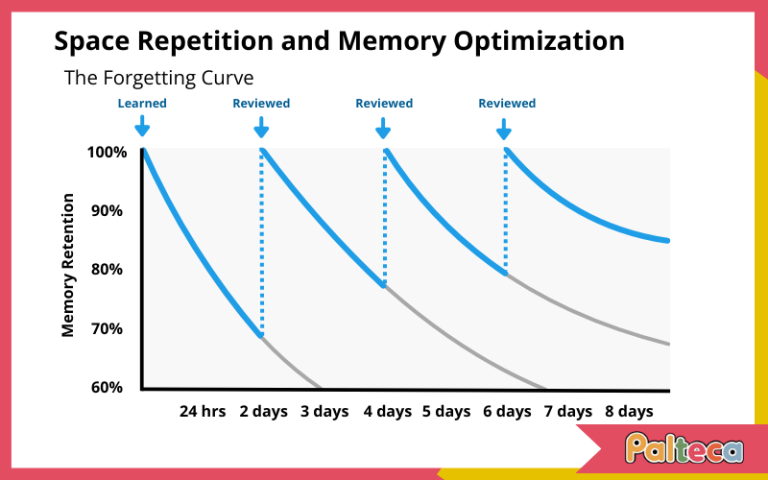
In the 1880s, German psychologist Hermann Ebbinghaus discovered what’s now called the “forgetting curve.” His research showed that without reinforcement, we forget approximately:
- 50% of new information within one hour
- 70% within 24 hours
- 90% within one week

This isn’t a flaw in your memory—it’s how human brains work. We’re designed to forget information we don’t actively use or review.
Now think about how Dreaming Spanish works. You watch a video. You hear the word “humano“. You picked it up the meaning from context. Great!
But then what?
There’s no system ensuring you’ll encounter “humano” again before you forget it. You might watch 50 more videos before hearing it again—by which point you’ve completely forgotten it and have to relearn it from scratch.
Now you may be wondering this was research done over 100 years ago, can it be trusted? Yes, study after study has not only had the same findings, but the timelines were very similar to the original study.
This is the curse of a content library without a curriculum: you’re constantly relearning the same words over and over again.
But before you go and search for a Dreaming Spanish alternative, let’s look at other ways this impacts your learning.
The Compounding Inefficiency
Let’s do some rough math. Say you encounter 20 new words in an hour of Dreaming Spanish content. Without spaced repetition:
- After one day, you’ve likely forgotten 14 of those words
- After one week, you’ve forgotten 18 of them
- The 2 words you remember? Probably ones you happened to encounter multiple times by chance
Now multiply this across hundreds of hours. You’re not building vocabulary efficiently—you’re watching a massive amount of content while retaining a fraction of what you’re exposed to.
This is why Dreaming Spanish requires 1,500+ hours to reach fluency, nearly double other productive methods. It’s not because comprehensible input doesn’t work—it’s because random passive exposure without systematic review is wildly inefficient.
What Actually Fights the Forgetting Curve
The solution to the forgetting curve is well-established: spaced repetition. By reviewing information at strategically increasing intervals (1 day, 3 days, 7 days, 14 days, etc.), you can move vocabulary from short-term recognition to long-term memory with far less total time investment.
You Can't Actually Use What You're Learning
Imagine this scenario: You’ve watched 200 hours of Dreaming Spanish. You’ve heard thousands of Spanish words in context. You feel like you’re making progress. Then you visit a Spanish-speaking country and try to order breakfast.
You freeze.
You know the word for “butterfly” (mariposa). You remember “library” (biblioteca). You picked up some interesting vocabulary about volcanoes from a documentary-style video. But “I’d like eggs and toast, please?” You’ve never encountered that specific combination—and there’s no guarantee you ever will.
This is the fundamental problem with learning from a content library instead of a curriculum: the vocabulary you encounter is determined by whatever order you went in, and whatever content creators happened to make, not by what you actually need to communicate.
A structured curriculum prioritizes high-frequency, high-utility vocabulary from the start. In the first few lessons, you learn to introduce yourself, ask basic questions, order food, handle transactions, and navigate common social situations. These aren’t random—they’re the building blocks that let you function in the real world.
Dreaming Spanish has no such prioritization. You might spend 50 hours watching videos at the beach and vlogs before you ever hear someone make a restaurant reservation. You might learn the names of exotic animals before you learn how to ask “where is the bathroom?”
The result? Hundreds of hours of input with gaping holes in practical, everyday vocabulary. You understand random topics at an intermediate level while struggling with beginner-level interactions that matter most.
You Won't Speak for Months—Or Years
Dreaming Spanish’s official roadmap recommends waiting until 600 hours of input before attempting to speak. Their reasoning? Speaking too early “will invariably result in hard-to-fix non-native pronunciation, noticeably bad grammar, and poor word usage.“
Let’s put that timeline in perspective:

For most people learning Spanish—whether for travel, connecting with family, career advancement, or building relationships—waiting years before speaking simply isn’t practical. You have a trip planned in six months. Your in-laws are visiting next year. Your job requires Spanish proficiency soon, not eventually.
But the timeline isn’t even the biggest problem. The deeper issue is that passive recognition and active production are fundamentally different skills.
You have to practice production – whether it’s writing or speaking. Production requires active vocabulary whereas listening requires only passive vocabulary.
You Won't Develop Grammar Intuition Efficiently
Here’s a common experience for Dreaming Spanish users: After hundreds of hours, you’ve absorbed that Spanish has masculine and feminine words. You’ve heard “el libro” and “la mesa” countless times. You have a vague sense that adjectives change too.
But when you try to speak or write, you’re guessing. Is it “soy delgado” or “soy delgada“? Does it depend on who’s speaking? Why do some adjectives seem to change and others don’t?
With thousands of hours of exposure—like a child gets—you’d eventually internalize these patterns unconsciously. But you don’t have thousands of hours. You have one hour a day, maybe, carved out of a busy adult life.
Here’s what children have that you don’t:
- 12-16 hours of daily immersion vs. your 1 hour
- Constant corrective feedback from caregivers who rephrase and respond
- Years of formal grammar instruction throughout school (yes, even native speakers study grammar)
- No competing language creating interference patterns
As an adult, you have something children lack: the ability to understand patterns explicitly. Show an adult “soy delgado” (masculine speaker) next to “soy delgada” (feminine speaker) with clear context, and they understand immediately. A child needs hundreds of exposures to unconsciously absorb the same pattern.
Research in second language acquisition shows that grammar correlates with faster acquisition for adult learners compared to purely implicit approaches.
You’re not a baby. Use your adult cognitive advantages instead of pretending you don’t have them.
The Core Methodology Is Controversial
Dreaming Spanish isn’t just “comprehensible input”—it’s based on Automatic Language Growth (ALG), a more extreme methodology developed by Dr. J. Marvin Brown in Thailand in the 1980’s.
Standard comprehensible input theory (from linguist Stephen Krashen) emphasizes meaningful exposure as the primary driver of language acquisition. ALG takes this further, claiming that adults can achieve native-like fluency if they completely avoid conscious learning: no grammar study, no speaking practice, no translation, no active memorization—for hundreds of hours.
The core claim is that adults can learn “like children” if they suppress their adult learning instincts. But this comparison has significant problems:
The exposure math doesn’t work. A one-year-old has received roughly 5,000-8,000 hours of language exposure before speaking their first words. At one hour daily, matching that would take 14-22 years. Dreaming Spanish isn’t replicating childhood immersion—it’s a tiny fraction of it.
Children receive constant interactive feedback. When a toddler says “I goed to store,” caregivers naturally rephrase: “Oh, you went to the store?” This feedback loop is entirely absent from passive video watching.
Even native speakers study grammar. Throughout school, native speakers receive explicit instruction in their own language’s grammar, spelling, and usage. The idea that grammar instruction is unnecessary contradicts how every native speaker actually learned to use their language correctly.
Adult brains are structurally different. Neuroplasticity decreases with age. Adults have entrenched L1 patterns that create interference. These aren’t obstacles that “trying to learn like a child” can overcome.
Even ALG proponents acknowledge the methodology lacks rigorous validation.
Comprehensible input is valuable. But wrapping it in an extreme ideology that dismisses grammar instruction, active practice, and speaking—and requires years of silent passive watching—is a choice, not based on any scientific research.
| Aspect | Comprehensible Input (CI) | Automatic Language Growth (ALG) |
| Developed by | Dr. Stephen Krashen | Dr. James Marvin Brown |
| Core idea | Understandable input drives acquisition | Input only, no conscious learning at all |
| Grammar study | Can supplement, especially if done in language that is being learned | Prohibited — “damages” acquisition |
| Speaking practice | “Speaking ability emerges on its own after enough competence has been developed by listening and understanding” | Prohibited until “can produce language spontaneously, without conscious effort” |
| Silent period | Not required | Required for hundreds of hours |
| Research backing | Well-established, widely accepted | Limited research, largely has never been done except by 1 school that later discounted its use |
| Flexibility | Can combine with other methods | Strict adherence required |
| Used by | Many apps, courses, teachers | Dreaming Spanish |
It’s worth noting that the school that Brown helped create, and one of the only ALG schools in the entire world stopped their ALG course recently. One user commented it was because the school was not capable of showing progression nor effectiveness.
Who Is Dreaming Spanish Actually For?
Based on this Dreaming Spanish review, the platform works best for a narrow subset of learners:
- Hobbyists with unlimited time who enjoy watching Spanish content without pressure for results
- Supplementary users who combine Dreaming Spanish with active learning methods (curriculum-based methods like Palteca, tutors, other apps)
- Listening-focused learners whose only goal is understanding Spanish media, not speaking it or reading and writing
- Learners who’ve exhausted other methods and need something low-pressure to stay engaged
If you want to actually speak Spanish within a reasonable timeframe, Dreaming Spanish alone probably isn’t the answer.
A Better Approach: Comprehensible Input + Systematic Learning
Here’s the thing: comprehensible input absolutely works. The science behind learning through meaningful exposure is sound. The problem with Dreaming Spanish isn’t the CI philosophy—it’s the lack of everything else that makes learning efficient.
What if you could have comprehensible input principles combined with:
- A structured curriculum that ensures systematic vocabulary coverage
- Spaced repetition that fights the forgetting curve
- Mnemonics that create stronger memory associations
- Speaking practice from Day 1 to build production alongside comprehension
- Daily insights on how we actually acquire language, and things you can do learn more effectively
This is exactly what Palteca offers.
Dreaming Spanish Vs Palteca
| Feature | Dreaming Spanish | Palteca |
| Learning Approach | Content library | Structured CI-based curriculum |
| Uses Translation | No—100% Spanish | No—100% Spanish |
| Spaced Repetition | None | Built-in Spaced Repetition System |
| Memory Techniques | None | Mnemonics integrated |
| Speaking Practice | Start after months or years of study | From Day 1 |
| Vocabulary Review | None | Systematic review cycles |
| Curriculum | No—browse by difficulty | Yes—sequenced learning path |
| Practical learning strategy tips | No | Yes—Daily Fluency Insights |
| iOS App | No | Yes |
| Android App | Yes | Yes |
| Web App | Yes | No |
| Pricing | $8/month | $15.99/month or $95.99/year |
Palteca isn’t anti-comprehensible input—it’s CI done right. You get meaningful Spanish exposure through a carefully designed curriculum, but with the systematic review and active practice that actually cements vocabulary into long-term memory.
Instead of watching random videos and hoping words stick, you’re progressing through a structured path where every word you learn is reinforced at optimal intervals. Instead of staying silent for 600 hours, you’re building speaking skills from your very first session.
The result? You actually retain what you learn, and you can speak—not just understand—Spanish.
The Final Verdict
This Dreaming Spanish review comes down to a simple question: do you want to just watch videos, not speak for years, while learning the slow way, or do you want to want to speak Spanish and learn Spanish efficiently?
Dreaming Spanish offers a massive library of quality Spanish content at an affordable price. If your only goal is improving listening comprehension and you have many years to dedicate to the process, it can work—especially as a supplement to other methods.
But as a standalone learning solution, Dreaming Spanish has critical gaps that makes it very inefficient way of learning. The lack of repetition means you’ll waste countless hours relearning forgotten vocabulary. The lack of curriculum means you’ll have gaps in essential words and patterns. The lack of speaking practice means your production will lag far behind your comprehension.
For most learners with real goals and limited time, Dreaming Spanish alone isn’t enough.
If you’re looking for a Dreaming Spanish alternative that has a system based on comprehensible input but with a mechanism that actually respects your time—with structured curriculum, spaced repetition, memory techniques, and speaking practice from Day 1—Palteca offers what Dreaming Spanish is missing.
Download Palteca today and experience the difference between a content library and a real learning system. Your future Spanish-speaking self will thank you.
Frequently Asked Questions
Is Dreaming Spanish free?
Partially. Dreaming Spanish offers many videos for free across difficulty levels. However, the majority of their video library requires a Premium subscription at $8/month. The free tier is generous for trying the method, but serious users will likely want Premium access eventually.
How long to does it take to be fluent using Dreaming Spanish?
According to Dreaming Spanish’s official roadmap, reaching Level 7 (“overall effective user of the language”) requires 1,500 hours of input. Here’s what that looks like in practice:
- At 15 minutes per day: 1,500 hours = 16.4 years
- At 30 minutes per day: 1,500 hours = 8.2 years
- At 1 hour per day: 1,500 hours = 4.1 years
This extended timeline is largely due to the inefficiency of a passive content library approach—without spaced repetition or structured curriculum, learners spend significant time relearning forgotten vocabulary and encountering words in random order rather than by usefulness.
More efficient learning methods that combine comprehensible input with spaced repetition, structured curriculum, and active practice—like Palteca—can achieve similar results in only ~750 hours, half the time than a Dreaming Spanish content library approach.
How long before you start to see results?
According to their roadmap, you’ll reach Level 3 (“can follow topics adapted for learners”) at 150 hours and Level 4 (“can understand a patient speaker”) at 300 hours. At 30 minutes per day, that’s 10 months to a year and a half before you reach a beginner-level comprehension.
But here’s the real problem: because Dreaming Spanish is a content library with no curriculum, you won’t be able to use what you’ve learned practically. You might understand random vocabulary from videos you’ve watched, but you won’t necessarily be able to introduce yourself, order food, or handle basic travel situations—skills a structured curriculum teaches in the first few weeks.
With curriculum-based approaches like Palteca, you can start using practical Spanish immediately. By the time a Dreaming Spanish user reaches 150 hours of passive watching, a Palteca user has already been speaking, practicing real-world scenarios, and building usable skills from day one.
Are there alternatives to Dreaming Spanish?
Yes—and if you want to actually speak Spanish (not just understand it), you should seriously consider them.
The best Dreaming Spanish alternatives combine the benefits of comprehensible input with the efficiency tools that Dreaming Spanish lacks: spaced repetition for vocabulary retention, structured curriculum for practical progression, grammar pattern recognition for faster learning, and speaking practice from day one.
Palteca is the strongest alternative for learners who believe in comprehensible input but want faster, more practical results. It offers a CI-based curriculum with built-in SRS, mnemonics, and speaking practice—addressing every major weakness of the Dreaming Spanish approach while staying true to the science of meaningful input. Available on iOS and Android for $9.99/month or $49.99/year.
Other options include using Dreaming Spanish as a supplement to active learning tools like Anki (for SRS flashcards) and italki (for speaking practice with tutors)—though this requires managing multiple apps and creates a fragmented learning experience.
Is Dreaming Spanish worth paying for?
For the right learner, Dreaming Spanish can be a useful tool—particularly as a supplement to other methods or for learners whose only goal is listening comprehension. The content quality is good, the price is affordable, and the comprehensible input part is scientifically grounded. However, as a standalone solution for learning to speak Spanish, Dreaming Spanish has significant limitations. The extremely inefficient vocabulary acquisition method, lack of a structured curriculum, waiting potentially years to begin to practice speaking Spanish, and no way to read or write, means most learners will achieve faster, more complete results with a Dreaming Spanish alternative, like Palteca.
Is Dreaming Spanish available on iOS (iPhone/iPad)?
No. At this time, Dreaming Spanish iOS app is not available on Apple’s App Store.
Looking for more reviews? Check out our guides to the best Spanish learning apps and how to use Spanish comprehensible input effectively.