

If you’re considering learning Spanish, one of your first questions is likely about difficulty: Is Spanish easy to learn, or are you facing years of frustrating struggle? The answer depends on what you’re comparing it to, but for English speakers, Spanish is objectively one of the most accessible foreign languages you can choose. Although, that doesn’t mean it won’t require significant effort, dedication, and patience.
Note: This guide focuses primarily on Spanish difficulty for native English speakers without previous foreign language experience, as this is where the most comprehensive research exists. Speakers of other Romance languages like Portuguese, Italian, or French will generally find Spanish even more accessible, while speakers of unrelated languages may face different challenges.
Table of Contents
The Official Assessment: Category I Language
The U.S. Foreign Service Institute, which trains American diplomats in foreign languages, classifies Spanish as a Category I language, the easiest category for English speakers. According to FSI research, Spanish requires approximately 600-750 hours of study to reach “General Professional Proficiency.”

To put this in perspective, FSI identifies four difficulty categories:
- Category I (24-30 weeks): Spanish, French, Italian, Portuguese, Dutch
- Category II (36 weeks): German, Haitian Creole, Indonesian
- Category III (44 weeks): Czech, Hebrew, Hindi, Russian, Thai
- Category IV (88 weeks): Arabic, Chinese, Japanese, Korean
Spanish sits in the easiest category alongside other Romance languages and a handful of others. English speakers need roughly 600-750 hours to achieve professional proficiency in Spanish, compared to 2,200+ hours for languages like Arabic or Mandarin Chinese.
This classification provides evidence-based confirmation: yes, Spanish is relatively easy to learn for English speakers. However, “easier than most languages” doesn’t mean “effortless” or “simple.” It means Spanish and English share enough fundamental structures (word order, vocabulary roots, and grammatical concepts) that learning Spanish requires bridging a smaller gap than most alternatives
What Makes Spanish Easy to Learn
When asking “is Spanish easy to learn,” the answer depends largely on linguistic features, like vocabulary, sentence structure, and pronunciation patterns. These are just a few of the feature that define how languages work. Fortunately for English speakers, Spanish possesses several linguistic characteristics that make it particularly accessible compared to most other languages.
Thousands of Cognates
English and Spanish share substantial vocabulary overlap through cognates and loanwords due to their shared Latin roots. This means a significant portion of Spanish vocabulary is at least partially recognizable with little study. Words like “information/información,” “music/música,” “hospital/hospital,” and “family/familia” require minimal effort to learn. This instant vocabulary recognition helps early progress and builds confidence in ways that learning languages in other categories simply cannot match. This helps make Spanish uniquely accessible within its linguistic family.
Among major world languages, only other Romance languages (French, Italian, Portuguese) have numerous similar cognates, offering English speakers a comparable advantage when learning these languages.
Consistent Pronunciation Rules
Spanish pronunciation follows remarkably consistent rules. Once you learn how each letter sounds, you can pronounce virtually any Spanish word correctly just by reading it. This contrasts sharply with English, where “rough,” “though,” “through,” and “cough” all pronounce “-ough” differently.
Spanish has five clear vowel sounds that remain consistent regardless of context. Consonants like “c,” “g,” and “r” follow predictable patterns based on position and surrounding letters. This consistency means you can start reading Spanish aloud with reasonable accuracy within weeks of beginning to learn.
While some sounds present challenges, particularly the simple “r” vs the rolled “rr,” these are learnable through practice. The overall simplicity of Spanish phonetics makes it far more approachable than languages like French (with nasal sounds and silent letters) or Thai (with tonal distinctions that change word meaning).
Grammatical Similarities
Spanish and English share fundamental grammatical structures due to Indo-European linguistic heritage. Both languages use subject-verb-object word order as the default, unlike Japanese or Arabic. Both distinguish between nouns, verbs, adjectives, and other parts of speech in recognizable ways.
Spanish grammar includes familiar concepts like past, present, and future tenses, plural forms, and descriptive adjectives. While in some cases Spanish handles these concepts differently than English, the underlying framework remains recognizable. You’re not learning entirely new grammatical concepts, you’re learning variations on familiar patterns.
Widespread Learning Resources
Spanish’s popularity as a second language means abundant, high-quality learning resources exist across all price points and learning styles. Apps, courses, tutors, podcasts, YouTube channels, textbooks, and immersion programs specifically targeting English speakers learning Spanish are widely available.
This abundance of resources makes finding materials suited to your learning style, goals, and budget straightforward. Whether you prefer structured courses, immersive content, conversation practice, or self-directed study, proven resources exist.
The Challenging Parts of Learning Spanish
Is Spanish easy to learn? Yes, but being easier than most languages doesn’t eliminate challenges. Several aspects of Spanish genuinely present difficulty for English speakers, and understanding these upfront prevents frustration.
Verb Conjugations

Spanish verbs change form based on subject, tense, and mood, far more extensively than English. While English has perhaps 4-5 forms for most verbs (walk, walks, walked, walking), Spanish verbs can have 50+ different forms when accounting for all persons, tenses, and moods.
Learning to conjugate regular verbs across common tenses (present, preterite, imperfect, future, conditional) requires memorization and practice. Spanish also has many high-frequency irregular verbs, adding additional complexity. This systematic conjugation, while logical, requires substantial effort to internalize.
Subjunctive Mood
The subjunctive mood, used to express wishes, doubts, hypotheticals, and emotions, barely exists in modern English but is used often in Spanish conversation. Understanding when and how to use subjunctive requires grasping conceptual distinctions about certainty and reality that English doesn’t explicitly mark grammatically.
Many English speakers struggle with the subjunctive mood for months or years, even as other aspects of their Spanish become fluent. It represents one of the clearest examples where Spanish complexity exceeds English, requiring patience and extensive exposure to master.
Gendered Nouns
Every Spanish noun has grammatical gender: masculine or feminine. The gender of nouns affects article choice, adjective endings, and pronoun references. English has virtually no noun gender (except he/she for people), making this concept foreign and requiring memorization for thousands of words.
While patterns exist (words ending in -o tend to be masculine, -a tend to be feminine), numerous exceptions and arbitrary assignments mean you simply must memorize gender alongside vocabulary. Early on, gender mistakes feel constant and frustrating, though they gradually decrease with exposure and practice.
Listening Comprehension at Natural Speed
Spanish speakers, particularly in conversations among native speakers, talk fast and blend words together in ways that obscure word boundaries. The clear, slow Spanish of learning materials contrasts sharply with the rapid-fire speech of actual conversation, movies, or podcasts.
This gap between Spanish spoken in the classroom and Spanish spoken in every-day situations creates a challenging transition period where you understand textbook exercises perfectly but struggle to catch even basic phrases in real conversation. Bridging this gap requires extensive listening practice and patience as your ear gradually adapts.
The Reality: Effort Required
Here’s the fundamental truth: Spanish being “easy to learn” means it’s easier compared to alternatives, not that learning Spanish is easy in absolute terms. Even learning the most accessible foreign language requires significant time, effort, mental energy, and persistence.
Learning Spanish to conversational fluency typically takes 1-2 years of consistent daily practice for English speakers. This means dedicating 30-60 minutes daily, every day, for months. It means pushing through plateaus where progress feels invisible. It means tolerating the discomfort of speaking poorly before speaking well. It means accepting mistakes as learning tools rather than failures.
You will feel frustrated. You will have moments where Spanish feels extremely difficult despite its Category I classification. You will wonder if you’re making progress. These experiences are normal for every language learner, regardless of how “easy” the target language theoretically is.
The “ease” of Spanish simply means these challenges resolve more quickly and completely than they would with more difficult languages. What might take 3-4 years in Japanese might take 1-2 years in Spanish. The journey still requires work, just less total work than harder alternatives.
Personal Factors That Affect Difficulty
While Spanish is relatively easy to learn for English speakers overall, you may be wondering: is Spanish easy to learn for me specifically? Your individual experience depends on personal factors beyond the language’s inherent characteristics.
Previous language learning experience dramatically affects difficulty. If Spanish is your first foreign language, you’re learning how to learn languages simultaneously with learning Spanish itself. You’ll need to understand how to study effectively, tolerate ambiguity, and start thinking in another language. Extra layer of language learning skill development adds difficulty that subsequent languages won’t require.
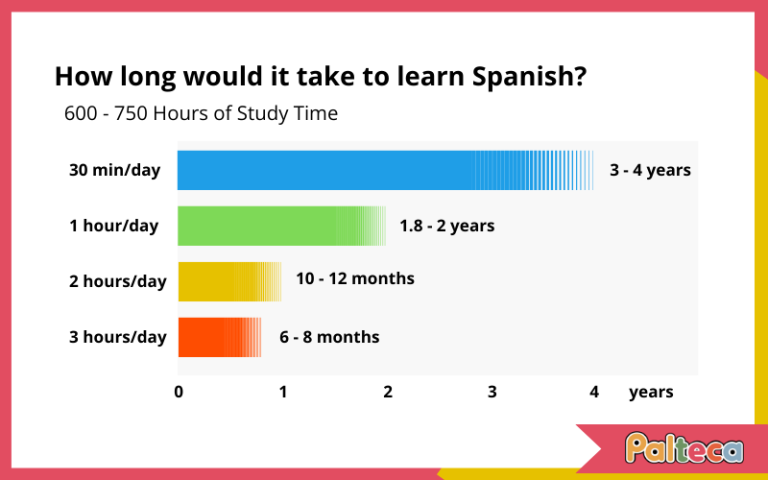
Available study time influences both speed and perceived difficulty. The same 600-750 hours of practice produces different timelines depending on daily commitment: at 30 minutes daily, reaching conversational fluency takes 3-4 years; at one hour daily, 2-2.5 years; at two hours daily, 1-1.5 years. Doubling your daily practice time roughly halves your timeline. However, consistency matters more than intensity. Daily 30-minute sessions feel sustainable and show steady progress, while sporadic weekend cramming creates frustration and poor retention even if weekly hours match. Regular exposure allows your brain to consolidate learning between sessions, making Spanish feel manageable rather than overwhelming.
Learning methods and resources substantially impact experience. Quality materials presenting information comprehensibly at your level feel manageable and motivating. Poor resources presenting overwhelming content create unnecessary frustration. Choosing effective learning approaches makes Spanish feel easier than it would with inefficient methods.
Motivation and goals affect persistence through difficult periods. Clear, compelling reasons for learning Spanish, like travel, family connections, career opportunities, or cultural interest, sustain effort through plateaus. Vague or obligatory motivation makes challenges feel insurmountable.
Aptitude and learning style play smaller roles than commonly assumed. While some people learn languages more naturally than others, the difference matters far less than factors like time invested and method quality. Practically anyone can learn Spanish with sufficient time and appropriate resources. It’s not a special talent.
Making Spanish Easier: Practical Strategies
While the question “is Spanish easy to learn” has a generally positive answer for English speakers, you can make the learning process even more efficient and less frustrating through strategic approaches.
Focus on high-frequency vocabulary first, the 1,000-2,000 most common words that comprise the majority of everyday speech. Mastering these core words provides functional communication ability faster than studying obscure vocabulary.
Prioritize Spanish comprehensible input, learning through content slightly above your current level that you can mostly understand. This natural exposure accelerates acquisition more efficiently than pure grammar study or vocabulary memorization.
Practice speaking early and often, even imperfectly. Waiting until you “feel ready” delays speaking indefinitely. Early speaking practice, despite mistakes, builds communication confidence and reveals exactly which vocabulary and grammar you actually need. Whether you’re using repetition, the shadowing technique, having practice conversations, or just talking to a mirror, this skill is crucial if you want to become fluent.
Use the spaced repetition method for vocabulary retention. These scientifically-backed tools optimize review timing, ensuring you remember what you study while minimizing wasted review time on already-mastered material.
Combine multiple methods rather than relying exclusively on one approach. Structured lessons build foundations, Spanish immersion content develops comprehension, conversation practice builds fluency, and strategically timed reviews maintains retention. A balanced use of these approaches produces better results than any single method alone.
If you’re looking for more techniques that can improve your Spanish learning, checkout our article, Language Learning Techniques: Proven Strategies to Be Fluent.
For Non-English Native Speakers
The question “is Spanish easy to learn” becomes more complex if English isn’t your native language, as your experience will differ significantly from this assessment. English itself is a Germanic language with heavy Romance language influence (particularly from French and Latin), which explains why English speakers find Spanish relatively accessible
Romance language speakers, particularly Portuguese, Italian, French, or Romanian speakers, will find Spanish even easier than English speakers do, thanks to shared grammar structures and vocabulary roots.
Germanic language speakers (German, Dutch, Norwegian) will have experiences similar to English speakers.
Speakers of unrelated languages (Mandarin, Arabic, Japanese, Korean, Hindi) may find Spanish more challenging initially. Though, Spanish generally remains more accessible than learning these languages as an English speaker would experience.
For specific guidance based on your native language background, consider consulting language-specific learning communities or resources tailored to your First Language to Spanish combination.

The Verdict: Yes, Spanish Is Relatively Easy
Is Spanish easy to learn? For English speakers, yes. Compared to most world languages, Spanish presents fewer fundamental obstacles and requires less total time investment to achieve fluency. The linguistic similarities, shared vocabulary, consistent pronunciation, and abundant resources make Spanish one of the most accessible foreign languages available.
However, this relative ease shouldn’t create unrealistic expectations. Spanish still requires significant time commitment, consistent practice, tolerance for mistakes, and persistence through challenging periods. You’ll invest hundreds of hours over months or years. You’ll struggle with concepts like subjunctive mood and rapid native speech. You’ll have moments of frustration alongside moments of breakthrough.
Remember that difficulty is part of learning, not a sign of failure. When Spanish feels hard (and it will at times) that doesn’t mean you’re bad at learning languages or that you’re not making progress. Struggling with verb conjugations, feeling lost during fast conversations, or forgetting vocabulary you thought you knew are all normal experiences that every successful Spanish learner has faced. These challenges aren’t obstacles to learning, they are the learning. Your brain is forming new neural pathways, and that process naturally involves difficulty. Pushing through these uncomfortable moments, making mistakes, and trying again is exactly how language acquisition works.
The advantage is that these challenges resolve more quickly and completely in Spanish than they would in most alternatives. What might require years in Mandarin or Arabic requires months in Spanish. The goal of becoming fluent in a new language remains the same. The path is simply shorter.
Ready to begin your Spanish learning journey? Palteca offers a comprehensive approach combining structured learning, native speaker content, and scientifically-backed retention techniques. The platform’s guided method helps you navigate Spanish’s learning curve efficiently, focusing effort where it matters most while building the consistent practice habits that lead to fluency.
The question isn’t whether Spanish is easy enough to learn, it absolutely is. The question is whether you’re ready to invest the effort required. If the answer is yes, Spanish rewards that effort more generously and quickly than most languages could.